Progress without Parity: The Journey of Women in Leadership
McKinsey’s latest report highlights a noteworthy advancement: Over the past decade the number of women breaking through the glass ceiling and stepping into leadership roles has risen significantly, with 29% now occupying C-suite positions, up from just 17% in 2015. This progress marks a pivotal shift, yet it only tells part of the story. Despite these achievements, women continue to be underrepresented in top leadership roles, hindered by entrenched systemic barriers within corporate structures.
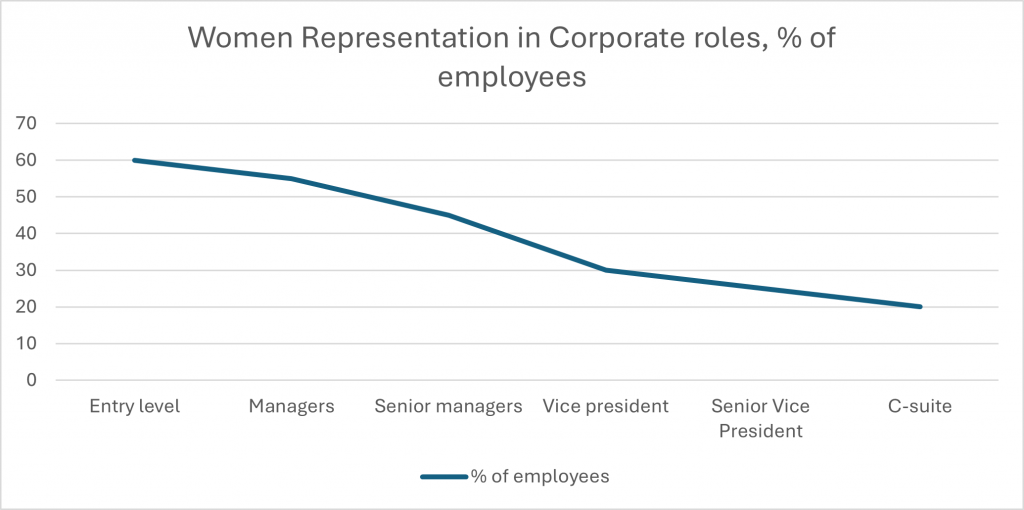
Source: Women in the Workplace 2024, Mckinsey and Company
Beneath the surface, a stubborn gender gap remains, especially at the critical entry and manager levels. For many women, the corporate pipeline is still more of a tightrope walk, with men continuing to outnumber them at every stage.
The challenge is deeper than the numbers. Unseen yet powerful forces—often called “second generation” gender bias—continue to shape leadership norms, making it harder for women to be seen as credible leaders. In cultures where leadership is equated with traits traditionally associated with men, women are left navigating a complex web of expectations, often needing to prove themselves twice over. Adding to this, the unconscious habit of men advocating for those who remind them of themselves reinforces the cycle, leaving fewer opportunities for women to rise.
Accordingly, achieving gender parity in leadership is still a distant goal, with current progress far too slow. At this rate, it will take 22 years for White women to reach leadership equality—and more than twice as long for women of colour.
Women in India questing for equal representation
In India, it is widely evident that pervasive unconscious biases and stubborn stereotypes surrounding women’s leadership abilities cast a shadow over their potential, significantly limiting their access to vital mentorship and development opportunities. While Asian women have seen improvements in the initial stages of their career progression, often referred to as the “broken rung,” they still encounter significant hurdles later in the pipeline. Many women also grapple with work-life balance challenges, with 80% taking career breaks, largely due to childcare and homemaking responsibilities. These issues, coupled with a lack of female mentors and limited leadership development programs, widen the confidence gap, making it even harder for women to rise into leadership roles.
Additionally, gender pay disparities and underrepresentation in senior positions complicate the landscape further. Currently, only 10% of Indian women occupy CXO roles, highlighting the systemic barriers that persist. Unfavorable workplace cultures that fail to support diversity often deter women from pursuing leadership positions altogether. This pattern underscores the need for targeted initiatives to address these disparities, promote inclusive work environments, and empower women to navigate their career paths more effectively.
Source URL — https://www.inspireone.in/the-journey-of-women-in-leadership/

Comments
Post a Comment